


|
|
|
|



 




|
||
| Information contained within this publication is based
upon Bernas Coni Warren's current understanding of taxation legislation and regulations. Although endeavours have
been made to provide accurate and timely information, we cannot guarantee that such information is accurate as of
the date it is received or that it will continue to be accurate in the future. No individual or company should act
upon such information without receiving appropriate professional advice after a thorough review of their particular
situation. We cannot accept responsibility for any loss as a result of acts or omissions. Tax treatment varies according to individual circumstances and is subject to change. The Financial Conduct Authority does not regulate Tax Planning or Inheritance Tax Planning. |
 |
|
| Taxation is a complex subject - only some rules and circumstances are covered here. |
|
|
CAPITAL GAINS TAX (CGT) INCOME TAX ...Main Allowances & Rates ...Income From Savings & Investments INHERITANCE TAX (IHT) ...Rates & Allowances ...Exemptions NATIONAL INSURANCE PENSION-PLAN INVESTMENT STAMP DUTY (Residential) TAX YEARS |
 |
| CAPITAL GAINS TAX | ||
| 2025-2026 | 2026-2027 | |
| Annual Exemption (for individuals): | £3,000 | £3,000 |
| Main Rate (below and within Basic Rate tax band): | 18% | 18% |
| Main Rate (above Basic Rate tax band): | 24% | 24% |
| Business Asset Disposal Relief (Entrepreneurs Relief) Limit (on top of Annual Allowance[s]): | £1,000,000 | £1,000,000 |
| Business Asset Disposal Tax Rate (up to Relief Limit): | 14% | 18% |
| What is liable to Capital Gains Tax? |
| In short, the profit made when selling an asset is liable to Capital Gains Tax (CGT) unless it's taxed in another way or is covered by a CGT exemption (e.g. your main residence). |
| The tax is payable by the person who profits. Taxable capital gains are added to income to determine the rate(s) of CGT to pay. |
| What are the CGT exemptions? |
| The most common exemptions are: |
| Annual Exemption: An allowance for every individual for tax-free capital gains during a tax-year. It's only the value of taxable gains (if any) in excess of this limit which is taxed. |
| Exempt Assets: Some assets are specifically exempt from CGT: such as ISAs, National Savings Certificates, approved pension schemes, your home and (usually) your chattels. |
| Inter-Spousal Transfers: Transfers of ownership between co-habiting UK-Domiciled husband and wife (and legal Civil Partners) are free from CGT. |
| Deferral Relief: Taxable gains can be rolled-over (to be taxed at a later date) if reinvested into shares of a qualifying unquoted trading company or Enterprise Investment Scheme. |
| Business Asset Disposal Relief (a.k.a. 'Entrepreneurs Relief'
prior to 06/04/2020): Large gains made by business-owners when selling (e.g. at retirement) are taxed slightly more favourably than other capital gains (up to the limit). |
| Is CGT payable on death? |
| Usually not. This prevents a potential double-taxation care of CGT and Inheritance Tax. |
| <Top of Page> |
||
| INCOME TAX | ||
| MAIN ALLOWANCES | ||
| 2025-2026 | 2026-2027 | |
| Allowances (applied to the FIRST part of your income) . . . | ||
| Personal Allowance: | £12,570 # | £12,570 # |
| Personal Allowance (Lower) Threshold: | £100,000 # | £100,000 # |
| Possible additional allowances . . . | ||
| Marriage Allowance (a.k.a. 'Transferable Tax Allowance') (both born after 05/04/1935) - Maximum: | £1,260 | £1,260 |
| Married Couple's Allowance (one or both spouses born before 06/04/1935) - Maximum: | £11,270 ^ | £11,698 ^ |
| Married Couple's Allowance (one or both spouses born before 06/04/1935) - Minimum: | £4,360 ^ | £4,525 ^ |
| ...Married Couple's Allowance Rate: | 10% | 10% |
| ...Married Couple's Allowance (Lower) Threshold: | £37,700 ^ | £37,700 ^ |
| Blind Person's Allowance: | £3,130 | £3,250 |
| Notes | ||
| # The Personal Allowance is reduced by £1 for every £2 of
'adjusted net' income in excess of the Personal Allowance (Lower) Threshold ... until reduced to £0. |
||
| ^ Married Couples Allowance is reduced by £1 for every £2 of gross income in excess of Married Couple's Allowance (Lower) Threshold ... until it's reduced to the Minimum Married Couple's Allowance. | ||
| MAIN RATES | ||
| (See the example, below) | 2025-2026 | 2026-2027 |
| Rates of tax (applied to your EARNED income ABOVE the allowances) . . . | ||
| Starting Rate (for unearned income, in some circumstances): | 0% * | 0% * |
| Starting Rate Tax 'Band' (for unearned income, in some circumstances): | £1 - £5,000 * | £1 - £5,000 * |
| Basic Rate (except Scotland): | 20% | 20% |
| Basic Rate Tax Band (except Scotland): | £1 - £37,700 | £1 - £37,700 |
| Higher Rate (except Scotland): | 40% | 40% |
| Higher Rate Tax Band (except Scotland): | £37,701 - £125,140 | £37,701 - £125,140 |
| Additional Rate (except Scotland): | 45% | 45% |
| Additional Rate Tax Band (except Scotland): | £125,141+ | £125,141+ |
| Notes | ||
| * Savings income is treated as being 'above' earned income. Some or all taxable savings income can be taxed at the Starting Rate only if earned income does not shift the savings income above the Starting Rate Tax 'band'. NB: the Starting Rate Tax 'band' forms part of the Basic Rate Tax band, rather than being additional to it. | ||
| Example ... | ||
| Alex is a single person, earns £60,000 and has no other income ... | Slice of Income | |
| On the first £12,570 of income, Alex pays £0 tax (Personal Allowance) | 0 - 12,570 | |
| On the next £37,700 of income, Alex pays £7,540 tax (20% Basic Rate) | 12,571 - 50,270 | |
| On the top £9,730 of income, Alex pays £3,892 tax (40% Higher Rate) | 50,271 - 60,000 | |
| <Top of Page> |
||
| MAIN SAVINGS & INVESTMENTS INCOME ITEMS | ||
| 2025-2026 | 2026-2027 | |
| Most Savings Income / Interest: | Usually no tax is deducted by the payer (paid gross) | Usually no tax is deducted by the payer (paid gross) |
| Personal Savings Allowance - Basic Rate payer: | £1,000 ^ | £1,000 ^ |
| Personal Savings Allowance - Higher Rate payer: | £500 ^ | £500 ^ |
| Personal Savings Allowance - Additional Rate payer: | £0 ^ | £0 ^ |
| Tax Rate - Basic Rate payer: | 20% | 20% |
| Tax Rate - Higher Rate payer: | 40% | 40% |
| Tax Rate - Additional Rate payer: | 45% | 45% |
| Dividends from UK Shares: | Treated as having had no tax deducted by the payer (paid gross) | Treated as having had no tax deducted by the payer (paid gross) |
| Dividends Allowance: | £500 ^ | £500 ^ |
| Dividends Tax Rate - Non-taxpayers: | 0% * | 0% * |
| Dividends Tax Rate - Starting Rate taxpayers: | 0% * | 0% * |
| Dividends Tax Rate - Basic Rate taxpayers: | 8.75% * | 10.75% * |
| Dividends Tax Rate - Higher Rate taxpayers: | 33.75% * | 35.75% * |
| Dividends Tax Rate - Additional Rate taxpayers: | 39.35% * | 39.35% * |
| Notes | ||
| ^ NB: savings and dividend income still counts in full for determining tax rates, Personal Allowance entitlement and the size of any entitlement to the Personal Savings Allowance itself. The Personal Savings Allowance and Dividends 'Nil-Rate' Allowance are effectively 0% tax-rate portions WITHIN (not additional to) existing tax bands. The Starting Rate tax band (for those eligible) still remains available. | ||
| * These rates apply only for any dividend income in excess of the Dividends Allowance. | ||
| <Top of Page> |
||
| INHERITANCE TAX | ||
| 2025-2026 | 2026-2027 | |
| Annual Gift Exemption: | £3,000 | £3,000 |
| Nil-Rate Band Threshold: | £325,000 | £325,000 |
| Residence Nil-Rate Band (Maximum): | £175,000 | £175,000 |
| Tax Rate (on death): | 40% * | 40% * |
| * For people leaving 10% or more of their net estate (i.e. after deducting Inheritance Tax exemptions, reliefs and the Nil-Rate Band) to charity, there is a reduction in the rate of Inheritance Tax from 40% to 36% levied on their estate. | ||
| What is liable to Inheritance Tax? |
| Gifts - either on death or during lifetime - are liable to Inheritance Tax (IHT) unless covered by one or more exemptions. |
| The tax is payable by the recipient(s) of the gift. |
| What are the Inheritance Tax exemptions? |
| The main exemptions are: |
| Nil-Rate Band ('NRB'): (see above) The first part of taxable estate on death is taxed at 0%. For married couples / legal civil partners ... the second-to-die can have their NRB increased by any unused percentage of the first-to-die's NRB. (If more than one previously-deceased spouse / partner, the maximum uplift is 100%). |
| Residence Nil-Rate Band ('RNRB'): (see above) For the residence property's net value passed on death to lineal descendant(s). NB: The RNRB is reduced (to a minimum of £0) for high-value estates. For married couples / legal civil partners ... the second-to-die can have their RNRB increased by any unused percentage of the first-to-die's RNRB entitlement. (If more than one previously-deceased spouse / partner, the maximum uplift is 100%). |
| Annual Gift Exemption: (see above) An individual may give away up to this amount per tax-year free from Inheritance Tax consequences. If this exemption was not used in the previous tax-year, then it can be carried forward to the current tax-year (but no further). |
| Normal Expenditure Relief: Gifts which are regular (e.g. monthly); repetitive (e.g. for 3+ years); are from the donor's income (not capital); and which don't materially reduce his/her standard of living may be covered by this exemption. An example is the premiums paid into a life insurance policy under trust. |
| Small Gifts: An individual may make gifts worth up to £250 per tax-year to as many recipients as (s)he likes. This is to cater for birthday presents etc. The exempt amount is PER RECIPIENT - not per donor. |
| Gifts in Consideration of Marriage: A gift made by a relative to individual(s) for their marriage. The limits are: up to £5,000 per parent; up to £2,500 per remoter relative or between the fiancé and fiancée; up to £1,000 from anyone else. |
| Inter-Spousal Transfers: Gifts or transfers of any size between UK-Domiciled husband and wife (or legal Civil Partners) are free from IHT. |
| Works of Art: Exemption from IHT might be granted for works of art, books, scientific collections etc. of national / scientific / historic / artistic interest. The owner has to agree to keep the items in Britain, preserve them, and allow reasonable public access. |
| Gifts to Charities or to Political Parties: These are immediately free from IHT. |
| Agricultural Property Relief and Business Property Relief: (Some relief may also apply to woodlands). Such property may be given either full (100%) or partial (50%) exemption to IHT. |
| Pension Benefits: Usually, death-in-service benefits and pension funds (prior to age 75) do not incur an IHT charge. However, the Labour Government announced on 30 October 2024 that they intend to impose IHT on these benefits from 6 April 2027 onwards. |
| Potentially Exempt Transfers ('PETs'): Gifts in lifetime to individuals (or to some trusts, such as for a disabled person) are 'PETs'. They remain in the donor's taxable estate FOR ONLY 7 YEARS. On death during this period, they become 'chargeable' (unless covered by an exemption). On death, chargeable gifts are cumulated and taxed chronologically: the oldest one forming the first part of the Nil-Rate Band ... then the next oldest ... and so on until the transfer made on death. |
| Chargeable Lifetime Transfers ('CLTs'): Gifts in lifetime to MOST types of trust are 'CLTs'. They generally remain in the donor's taxable estate FOR ONLY 7 YEARS. On death, chargeable gifts are cumulated and taxed chronologically: the oldest one forming the first part of the Nil-Rate Band ... then the next oldest ... and so on until the transfer made on death. A CLT can suffer IHT charges: (i) when the gift is made, if it (plus any non-exempt gifts within the previous 7 years) exceeds the Nil-Rate Band - at the Lifetime Rate (half of the death rate); (ii) later on if the value of the trust exceeds the Nil-Rate Band. NB: If there were any CLTs made within the 7 years prior to a PET (see previous section) or another CLT, and death occurs within 7 years of this latter gift, then the original CLT is still brought into the equation (even though it was made up to 14 years ago!) |
| Taper Relief: (see below) Applies if a lifetime gift incurs an IHT liability because the donor dies within 7 years: the tax (if any) on the gift is reduced. |
| How does Inheritance Tax 'Taper Relief' work? | |
| Taper Relief applies if a lifetime gift (PET or CLT) incurs an IHT liability on death. | |
| If the donor dies within 7 years ... and the cumulative value of the lifetime gift(s) exceeds* the Nil-Rate Band as at the date of death: | |
| Years ago the lifetime gift was made | Percentage of the death rate payable |
| 0 - 3: 3 - 4: 4 - 5: 5 - 6: 6 - 7: |
100% 80% 60% 40% 20% |
| Tax payable on death in respect of a lifetime gift is payable by the recipient of the gift. | |
| * | If the cumulative value doesn't exceed the
Nil-Rate Band (NRB), then it's still taken into account as far as use of the NRB is concerned - but Taper
Relief wouldn't apply as there's no tax to reduce. Here's an example: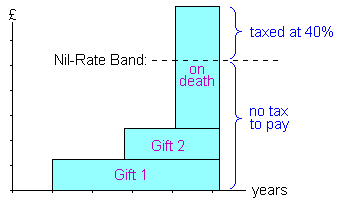 In this example, the cumulative value of the non-exempt lifetime gifts doesn't exceed the NRB - but it does reduce the amount of NRB available for setting against the value of the estate on death. |
| Can I give something away but still benefit from it? |
| Generally speaking, if you make a gift but continue to enjoy some benefit from it, then it is a 'Gift With Reservation' (GWR). This, for Inheritance Tax purposes, effectively means that it is not an effective gift. |
| <Top of Page> |
||
| NATIONAL INSURANCE | ||
| 2025-2026 | 2026-2027 | |
| Employees | ||
| Primary Earnings Threshold (PT): | £12,570 p.a. | £12,570 p.a. |
| Upper Earnings Limit (UEL): | £50,270 p.a. | £50,270 p.a. |
| Class 1 contributions on earnings up to PT: | 0% | 0% |
| Class 1 contributions on earnings between PT and UEL: | 8% | 8% |
| Class 1 contributions on earnings above UEL: | 2% | 2% |
| Class 3 per week (voluntary): | £17.75 | £18.40 |
| Self-Employed | ||
| Small Profits Threshold (SPT): | £6,845 p.a. | £7,105 p.a. |
| Class 2 per week: | £0 # | £0 # |
| ... PLUS ... | ||
| Class 4 Lower Profits Limit (LPL): | £12,570 p.a. | £12,570 p.a. |
| Class 4 Upper Profits Limit (UPL): | £50,270 p.a. | £50,270 p.a. |
| Class 4 contributions on earnings up to LPL: | 0% | 0% |
| Class 4 contributions on earnings between LPL and UPL: | 6% | 6% |
| Class 4 contributions on earnings above UPL: | 2% | 2% |
| Class 3 per week (voluntary): | £17.75 | £18.40 |
| Notes | ||
| # Or £3.50 per week (2025-26) / £3.75 (2026-27) voluntary, if profit is below the Small Profits Threshold (SPT) - to maintain contributory benefits (e.g. State Pension). | ||
| <Top of Page> |
||
| PENSION-PLAN INVESTMENT | ||
| The maximum total annual investment for
tax-relief purposes is the higher of: £3,600 p.a. or 100% of earnings (up to an Annual Allowance limit). (These figures are gross of tax relief). |
||
| 2025-2026 | 2026-2027 | |
| Annual Allowance (in most circumstances): | £60,000 | £60,000 |
| An individual's Annual Allowance may be smaller in some circumstances. | ||
| The Annual Allowance may be carried-forward for up to 3 years. | ||
| <Top of Page> |
||
| STAMP DUTY | ||
| Stamp duty for most purchases of residential land and buildings etc... | ||
| The following excludes Scotland (where Land and Buildings Transaction Tax applies). | ||
| The duty payable is based on applying each band rate to each SLICE
of the property's value: |
||
| Main Residence First-Time Buyers only... | 01/04/2025- | 01/04/2026- |
| Up to £300,000 (if price is <= £500,000): | 0.0% | 0.0% |
| £300,001 - £500,000 (if price <= £500,000): | 5.0% | 5.0% |
| See main residence rates if purchase price is: | £500,001+ | £500,001+ |
| Main Residence Rates... | 01/04/2025- | 01/04/2026- |
| Up to £125,000: | 0.0% | 0.0% |
| £125,001 - £250,000: | 2.0% | 2.0% |
| £250,001 - £925,000: | 5.0% | 5.0% |
| £925,001 - £1,500,000: | 10.0% | 10.0% |
| £1,500,001 and over: | 12.0% | 12.0% |
| Additional / Second Property Rates... | 01/04/2025- | 01/04/2026- |
| Up to £125,000: | 5.0% | 5.0% |
| £125,001 - £250,000: | 7.0% | 7.0% |
| £250,001 - £925,000: | 10.0% | 10.0% |
| £925,001 - £1,500,000: | 15.0% | 15.0% |
| £1,500,001 and over: | 17.0% | 17.0% |
| <Top of Page> |
||
| TAX YEARS | ||
| WHY 5 APRIL? | ||
| Tax years for individuals run from 6 April in one year to 5 April in the next year. | ||
| Prior to the 1750's, it was normal to start the year in Spring on 25 March ('Lady Day', the 'Feast of the Annunciation'). | ||
| 1 January was adopted as the formal start of the year, as a result of Great Britain changing from the Julian Calendar to the Gregorian Calendar. | ||
| This change required that the day following 2 September 1752 would be 14 September - a jump of 11 days. | ||
| Not wishing to be accused of 'taxation by stealth', the government of 1752 extended the 1752-1753 tax-year by 11 days to end on 5 April 1753 instead of on 25 March. | ||
| <Top of Page> |
||
|
|
| © Copyright Bernas Coni Warren |
www.BernasConiWarren.com 01275
83 73 03 01275
83 73 037 School Close, Whitchurch, Bristol, BS14 0DU |
| Bernas Coni Warren is a trading style of South Somerset Mortgages Limited which is an appointed representative of Quilter Financial Services Limited, which is authorised and regulated by the Financial Conduct Authority. Quilter Financial Services Limited is entered on the FCA Register under reference number 440703. |