


|
|
|
|



 




|
||
| The value of pensions and the income they produce can fall as well
as rise. You may get back less than you invested. Tax treatment varies according to individual circumstances and is subject to change. Transferring out of a Final Salary scheme is unlikely to be in the best interests of most people. Auto Enrolment is not regulated by the Financial Conduct Authority. National Employment Savings Trusts (NEST) and Small Self-Administered Schemes (SSAS) are not regulated by the Financial Conduct Authority. |
||
Pensions can be a complex subject and only the main types and rules for private (non-State) schemes are covered here. We advise clients on only Personal Pensions, Stakeholder Pensions, Drawdown and Annuities. Auto-Enrolment is by referral only. We cannot provide advice on defined benefit (a.k.a. 'final salary') transfers. |
|
|
SCHEME TYPES ...The Main Types of Schemes STAKEHOLDER PENSIONS ...Employers ...Tax Relief ...Charges CURRENT RULES ...Investment Limits & Tax Relief ...Retirement Age ...Cash Lump Sum ...The Pension Income ...Death Benefits PENSION OPTIONS AT RETIREMENT ...Options for the Income ...General Options THE COST ...of financial independence |
 |
| TYPES OF PENSION SCHEMES | |
| There are several types of private pension schemes. The main ones are as follows. | |
 OCCUPATIONAL PENSION SCHEME (OPS):
Provided by an employer. Employees might have to contribute. The pension income will be based on either: (i) whatever the fund is worth ('Money Purchase' or 'Defined Contribution') or (ii) final salary and the number of years of service with the employer ('Final Salary' or 'Defined Benefit'). There might be a death-in-service lump sum and dependants' pensions. |
|
|
ADDITIONAL VOLUNTARY CONTRIBUTION (AVC): Accompanies an OPS for extra contributions you might make. Managed by either the main scheme (an 'In-House AVC') or by a pension company of your choice (a 'Free-Standing AVC [FSAVC]'). |
|
|
RETIREMENT ANNUITY CONTRACT (RAC): No longer available (but contributions may still be made into an RAC by anyone who has one if still eligible to contribute). RACs were for people earning but not in an OPS. The pension income will be based on whatever the fund is worth ('Money Purchase'). An RAC is owned by you (not by your employer). |
|
|
PERSONAL PENSION SCHEME (PPS): For people who earn but who are not in an OPS. Can be set up as part of a Group scheme (GPPS). A PPS is owned by you (not by your employer). There may be life cover as well as pension investment. The pension income will be based on whatever the fund is worth ('Money Purchase'). Nowadays, new schemes are usually 'Stakeholders' instead. |
|
|
STAKEHOLDER PENSION (SHP): A flexible, low-charging individual scheme, which is a modern version of a PPS. Can be set up as part of a Group scheme (GSHP). An SHP is owned by you (not by your employer). The pension income will be based on whatever the fund is worth ('Money Purchase'). > See the Stakeholder section (below) for more details. |
|
|
NATIONAL EMPLOYMENT SAVINGS TRUST (NEST): A low-charging scheme, run by a not-for-profit trustee corporation. The pension income will be based on whatever the fund is worth ('Money Purchase'). |
|
|
SECTION 32 BUY-OUT (S32): Holds a transfer value taken from an OPS, where the employee has left that employer and wishes to have personal control over the fund. |
|
|
SMALL SELF-ADMINISTERED SCHEME (SSAS): A type of OPS allowing company directors to set up a tailored pension scheme for themselves. |
|
 |
|
| The above is only a basic outline of the main types. | |
<Top of Page> |
|
| STAKEHOLDER PENSIONS | |
| A Stakeholder Pension is a flexible, personally-owned, low-charge pension scheme. | |
| If you are UK resident, you're probably eligible to have one. You can be employed, Self-Employed, working but unpaid, or even not working. | |
| There is no minimum age - so even children can have Stakeholder pension plans. Grandparents, parents, guardians, etc. can invest into one for a child. | |
| Employers | |
| Employers must offer access to a pension scheme, such as a Stakeholder scheme, to their staff ... unless eligible for exemption (e.g. because there's another good pension scheme already in place). | |
| Tax Relief | |
| Individuals invest net of Basic Rate Tax relief. The pension scheme collects this tax relief from the State. So: to get £1,000 invested, an individual need contribute only £800 net. | |
| Higher Rate taxpayers can claim extra tax relief via the annual Tax Return. | |
| Additional Rate taxpayers can claim extra tax relief via the annual Tax Return. | |
| As with virtually all pension schemes, the fund is allowed to grow in a tax-efficient environment. | |
| At retirement, up to 25% of the fund may be withdrawn as a tax-free cash lump sum. | |
| Charges / Running Costs | |
| Stakeholder pensions have their administration charge capped at a very low level. The maximum is just 1.5% p.a. for the first 10 years, after which it's just 1% p.a. | |
| NB: The maximum charge does not necessarily include the cost of any ongoing adviser's service. The adviser's initial research and initial advice needs to be paid for as well. | |
<Top of Page> |
|
| CURRENT RULES | |
| People affected by the rules are UK resident and can be employed, Self-Employed, working but unpaid, or even not working. | |
| Investment Limits | |
| For individuals, the maximum allowed size of investment for tax-relief purposes is £3,600 p.a. ... or ... 100% of earnings (up to a limit) if higher. | |
| The £3,600 figure applies even if you have no earnings. | |
| For an employer, there is no limit set for the amount which can be contributed: it's up to the local Tax Office to decide on the amount of tax relief available. | |
| Mind you, there is an 'Annual Allowance' . . . | |
| Annual Allowances & Tax Relief | |
| There's an Annual Allowance which is a
maximum for total tax-relievable pension contributions. For most people, it's as follows: -- £40,000 in 2020-21 -- £40,000 in 2021-22 -- £40,000 in 2022-23 -- £60,000 in 2023-24. |
|
| Very high earners can find that their Annual Allowance is reduced to a much lower limit than is available for most people. | |
| Unused Annual Allowance can be carried-forward for up to 3 years. | |
| Contributions in excess of the Allowance (whether paid by the individual or their employer) would be subject to a tax charge at the individual's marginal rate (by adding the excess to their other taxable income). The tax charge is levied on the individual. | |
| For final salary ('defined benefit') schemes, the Annual Allowance is based on the increase in value of the benefit: £16 for each extra £1 p.a. of pension benefit. | |
| Payments which do NOT count towards the Annual Allowance include: | |
|
a contribution from an individual in excess of 100% of earnings (because no tax relief would be given) (a pension provider might not accept such a contribution, mind you) | |
|
a transfer between registered schemes | |
|
some pension credits granted on divorce | |
|
contributions into a non-registered scheme |
| Usually, individuals invest net of Basic Rate Tax relief. The pension company collects this relief from the State. So for each £1,000 invested, an individual needs to contribute only £800 net. | ||
| The £3,600 p.a. figure mentioned above is gross. The net-of-Basic-Rate-Tax-relief amount payable is currently £2,880 p.a. / £240 p.m. | ||
| Higher Rate taxpayers can claim extra tax relief via their annual Tax Return. | ||
| Additional Rate taxpayers can claim extra tax relief via their annual Tax Return. | ||
| Funds invested into registered schemes are allowed to grow in a tax-efficient environment. | ||
| Retirement Age | ||
| The minimum allowable pension age for registered schemes increased on 06/04/2010 from 50 to 55. It will increase again on 06/04/2028 to 57. | ||
| There are rules (not covered here) for people in certain occupations, such as sportsmen, police, etc. | ||
| People in serious ill-health may take benefits early. | ||
| Prior to the Budget on 22/06/2010, the maximum pension age was 75. However, the government abolished the obligation to 'annuitise' prior to reaching age 75. Pension income may be delivered after age 75 through an annuity or 'Income Drawdown' (see below). | ||
| Cash Lump Sum | ||
| ALL schemes now allow members to take up to 25% of the fund as a tax-free cash sum. | ||
| Some pre-06/04/2006 schemes can offer more than 25% as tax-free cash. In general, this is protected - but a transfer out could cause this protetion to be lost. | ||
| Nowadays, there are fewer restrictions than there used to be on how people can access their pension funds: since April 2015 the whole pension fund may be withdrawn as a lump sum - although there are usually undesirable tax consequences from doing so, plus the even-more-unpleasant risk of running out of money later on in life. | ||
| The Pension Income | ||
| The remaining pension fund (or all of it if no cash sum is taken) is usually used as follows... | ||
| ...to buy a 'secured' pension: (a guaranteed lifetime
annuity income or scheme pension); or ...put into an 'Income Drawdown' arrangement; or ...a combination of these two. |
||
| Income Drawdown: The pension fund remains invested. An income can be drawn, if/when required. NB: If you take too much too early and/or if the fund doesn't grow as well as expected, then you might face a drop in income at a later age, which could be very undesirable! |
||
| Death Benefits | ||
| With Occupational Pension Schemes... on death pre-retirement, there may be a tax-free lump sum death benefit (such as a multiple of salary). In addition, there's likely to be a spouse's and/or dependant's pension income if the scheme is a final-salary / defined-benefit one. | ||
| For money-purchase / defined-contribution schemes... on death prior to age 75, any remaining benefits such as the fund value can be paid out tax-free. On death from age 75 onwards, there is usually tax to pay. | ||
| Death benefits from a Drawdown arrangement... are tax-free if death occurs before age 75, but if from age 75 onwards there's usually tax to pay. | ||
<Top of Page> |
||
| PENSION OPTIONS AT RETIREMENT | ||
| Options for the Income | ||
| The structure of your private pension income can depend on the type of pension scheme(s) you have. | ||
| Converting a pension fund into an annuity (a pension income for life) is known as 'vesting'. | ||
| There are several styles for how your annuity might be paid. These must be arranged PRIOR to vesting. | ||
| Here are some examples: | ||
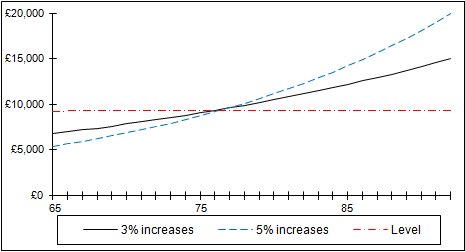
| Increases: The income could be non-increasing ... or escalate at say 3% p.a. / 5% p.a. / inflation-proofed. Some schemes have 'Limited Price Indexation' (LPI), meaning that they are inflation-proofed up to 5% p.a. Alternatively, there are some annuities where the income varies (down as well as up) because it's based on the value of an underlying fund. |
||
| Spouse's Benefit: Your widow(er) could have no benefit, half, 2/3rds or all of your pension: payable for his / her lifetime after you have died. |
||
| Frequency of Payments: The income could be paid monthly, quarterly, half-yearly or yearly. |
||
| Guaranteed Period: A minimum number of initial years (e.g. 5 or 10) during which the income will continue (to your partner / estate), if you were to die during this period. |
||
| Lump Sum Payment: All schemes now allow you to take part of the fund as a cash sum. The remaining fund being used to provide your annuity / income. |
||
|
||
| NB: with most types of pension scheme, the amount of pension income you'll start off with depends on the size of your fund. | ||
| Some of the above options will reduce the size of pension income you receive, at least to start off with. For example: | ||
 (source = Bernas Coni Warren) |
||
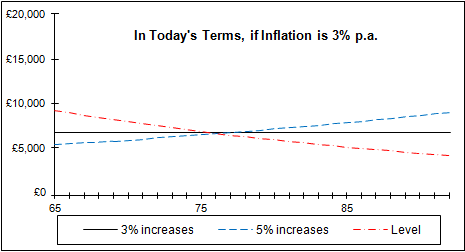
| At retirement, you need to consider the longer-term need
for income for yourself (and partner, if any), as well as your immediate need. For example, the same pensions shown above, when taking inflation into account at an illustrated steady rate of 3% p.a. look like this: |
||
 (source = Bernas Coni Warren) |
||
| General Options | ||
| Using The Existing Provider: Accepting the annuity offered by the existing pension scheme provider. Whilst this may not give you the highest income, it requires only a minimum of effort / paperwork. |
||
| Shop Around: Financial Advisers (like us) who aren't tied to just one company can transfer your fund to an alternative annuity provider. This could get you a higher guaranteed income and/or the style of benefits you desire. |
||
| Ill-Health & Enhanced Annuities: If you (and/or spouse) smoke or are overweight or have a medical condition which might possibly shorten your life-expectancy, then some annuity providers would pay a higher pension income to you. As per the previous paragraph, we can shop around to achieve the right result. |
||
| Deferred Vesting: This means starting some or all of your pension income at a later date. All else being equal ... the older you are when you vest a pension = the higher the income should be. This is simply because the older you are when you start a pension = the shorter your remaining life expectancy is. NB: It is a possibility that the fund might not grow in value, and/or that the annuity rates at a later date might be less favourable than they are currently, mind you. |
||
| Phased / Staggered Vesting: It may be possible to split your fund into a number of 'mini plans' and vest them individually over a number of years. (Or if you already have several pension plans, vest a couple when you retire ... others later on). The potential benefit is that the older you are when a portion is vested, the higher the income should be from that portion. NB: the funds might not grow, and/or future annuity rates might not be as good. |
||
| Income Drawdown: Provides flexible income from the fund which (net of the amounts withdrawn) continues to remain invested. (see the Current Rules section, above). But NB: the balance of your fund might not grow sufficiently well ... and/or interest rates might fall ... so the size of future income could fall. If you take too much out too soon, there may not be enough for later on in life. Also, if your pension funds total less than £100,000, then this route may not be for you, because smaller funds are more vulnerable to adverse performance and plan charges. |
||
| Pension Guidance: Because of the number of options available, and especially because it's now possible to withdraw the whole of some pension funds as cash (albeit suffering a tax hit) the government has introduced a 'pensions guidance guarantee'. So ... a good place to start is The Money Helper Website (https://www.moneyhelper.org.uk). |
||
| <Top of Page> |
||
| THE COST OF FINANCIAL INDEPENDENCE | ||
| Achieving financial independence (i.e. retiring with sufficient income to maintain your desired standard of living) is, in essence, just a question of 'putting money to one side' whilst earning. That money will be used later on - to provide an income so that you no longer have to work. | ||
| It's a case of spreading your earnings over a period longer than your work-life. | ||
| The money put to one side should be invested, and will ideally grow in value faster than the rate of inflation. Tax relief on each pension scheme investment you make helps it to gain value straight away. | ||
| When estimating how much you should invest, there are numerous factors to take into account - not least of which is how much you can afford! A general rule of thumb for many of us might be that we should invest a monthly amount which is as high as possible without it actually 'hurting'. | ||
| Some Factors To Take Into Account | ||
| To be more specific, here are a few of the many factors which can affect the amount which you should invest: | ||
|
-- your current age -- the age at which you want to retire -- the assumed growth rate of your pension funds -- the assumed rate of future inflation -- the amount of tax relief to be added -- how much private (non-State) pension income you are likely to need -- whether or not you'll need a pension benefit for your spouse / partner if you were to predecease them -- the existing pension benefits (if any) which you have accrued -- whether you will have other funds coming your way which you'll be able to use -- the rate at which your regular investment is increased in future years. |
||
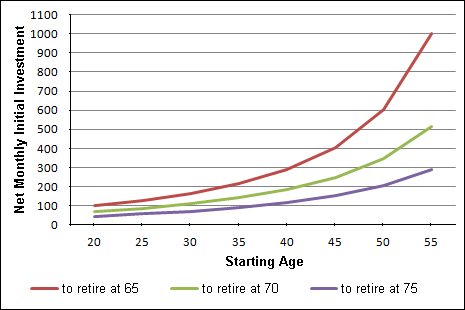
| Here's a chart which, although based on actual annuity rates (as at the time it was created), uses numerous calculations and a set of assumptions - so you should treat as being for general illustrative purposes only: | ||
 (source = Bernas Coni Warren) |
||
| This chart shows how much you might need to start off investing each month, net of Basic Rate tax relief, at various ages in order to achieve a private pension income equivalent to about £10,000 p.a. gross in today's terms. The chart ignores any State Pension to which you might be entitled. | ||
| Here are some of the assumptions used for creating the chart: -- a pension fund growth rate of a steady 7% p.a., net of charges -- an inflation rate of a steady 3% p.a. -- the pension annuity you buy at retirement increases at 3% p.a. -- your regular investment increases in future years at 3% p.a. -- the amount of tax relief added to each investment is 20% -- no spouse's pension benefit would be required -- there are no other pension benefits accrued -- no tax-free cash sum is to be taken at retirement age -- the pension annuity has an initial guaranteed period of 5 years. |
||
| The two key points illustrated here are: (1) The earlier you start investing for your retirement = the lower the monthly cost; (2) The monthly cost is lower for later retirement ages. This is because you'd be investing for a longer period and drawing the benefit for a shorter period. |
||
| The value of pensions and the income they produce can fall as well as rise. You may get back less than you invested. | ||
<Top of Page> |
||
| FURTHER INFORMATION | ||
| Please contact us [opens in a new window/tab] if you would like further information. | ||
| Levels of and bases of and reliefs from taxation are subject to change. | ||
| The editorial here does not constitute personal advice. It reflects Bernas Coni Warren's understanding of current law and tax practice, and is without prejudice. No liability shall attach. Errors & Omissions Excepted. |
| © Copyright Bernas Coni Warren |
www.BernasConiWarren.com  01275
83 73 03 01275
83 73 037 School Close, Whitchurch, Bristol, BS14 0DU |
| Bernas Coni Warren is a trading style of South Somerset Mortgages Limited which is an appointed representative of Quilter Financial Services Limited and Quilter Mortgage Planning Limited, which are authorised and regulated by the Financial Conduct Authority. Quilter Financial Services Limited and Quilter Mortgage Planning Limited are entered on the FCA Register under reference numbers 440703 and 440718 respectively. |