


|
|
|
|



 




|
||
| Life Assurance is a complex subject and only some elements are covered here. The Financial Conduct Authority does not regulate Estate Planning or Inheritance Tax planning. |
||
|
WHOLE OF LIFE ENDOWMENT TERM INSURANCE HEALTH-RELATED |
 |
| TYPES OF LIFE ASSURANCE |
| What are the different types? |
| There are several types and variations of life assurance. The main ones are listed below. |
 |
WHOLE-OF-LIFE (WOL) | |
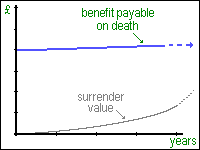
| Pays a lump sum on death, whenever it occurs. The size of lump sum might be fixed or variable. Typical uses are for: Estate planning for Inheritance Tax, general financial protection and to pay for funeral costs etc. |
 |
|
|
ENDOWMENT | |
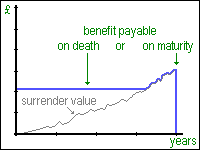
| A savings plan with some built-in life insurance cover. Pays out a lump sum on death if you die during its term or a lump sum on your survival to the end of the term. Could be used for business co-owners' share purchase purposes, for example. |
 |
|
|
LOW-COST ENDOWMENT (LCE) |
|
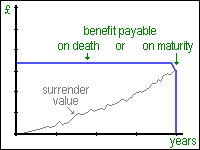
| An endowment with a greater emphasis on protection
(the built-in death benefit is higher). Most commonly used for repaying a mortgage. The death benefit is usually about the same size as the relevant mortgage debt. |
 |
|
|
LOW-START ENDOWMENT |
|
| The premium (cost) starts off lower but increases yearly for a few years. | ||
|
TERM INSURANCE | |
| Pays out the benefit if death occurs during the term of the policy (the 'term' being X years or before age Y). | ||
| On survival to the end of the term, cover usually just ceases, with no accrued value to the policy - similar to car insurance. | ||
| Because there's no investment element, term insurance is the cheapest type of life assurance. | ||
| Some variations are shown below . . . |
||
|
LEVEL TERM INSURANCE (LTI) | |
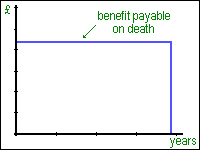
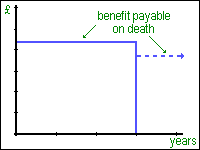
| The size of the potential benefit is fixed. The most frequent use is for family financial protection. Level Term Insurance cover is also valuable in a number of circumstances, such as for business co-owners' protection. |
 |
|
|
CONVERTIBLE TERM ASSURANCE (CTA) |
|
| Usually level cover with the extra benefit of being
able to alter the cover later on - usually with little or no further medical evidence. Under normal circumstances, the right to convert cannot be refused by the life office. The cover might be altered to another term insurance / a whole-of-life policy / an endowment. The cost of the new cover is based upon its type, size of benefit, duration, and your age at the time of converting. |
 |
|
|
DECREASING TERM INSURANCE (DTI) |
|
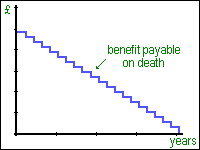
| The size of the lump sum death benefit decreases
(usually by equal amounts) during the policy's term. A popular use is for family financial protection. |
 |
|
|
FAMILY INCOME BENEFIT (FIB) |
|
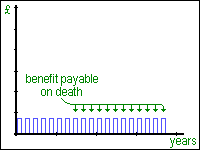
| A type of Decreasing Term Insurance, although it may
not look like it. Instead of a lump sum payable on death, the benefit is payable in regular instalments which last until the end of the policy's term. The most frequent use is for family financial protection. |
 |
|
|
MORTGAGE PROTECTION (MDTA) |
|
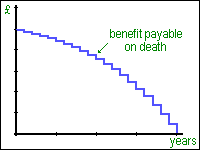
| A type of Decreasing Term Insurance. The size of benefit decreases in line with the amount of capital outstanding under a repayment ('capital and interest') mortgage. |
 |
|
|
GIFT INTER VIVOS COVER |
|
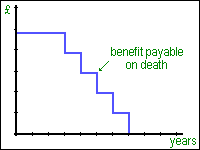
| The size of death benefit decreases in line with
the potential Inheritance Tax liability due on death in respect of a lifetime gift which exceeds the
Nil-Rate Band. The cover lasts for 7 years. |
 |
|
|
INCREASING TERM INSURANCE (ITI) |
|
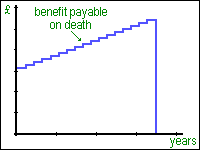
| The size of the lump sum benefit payable on death
gradually increases during the term of the policy. Increases in the size of cover are generally added yearly. The most frequent use is for family financial protection. |
 |
|
| There are other variations as well, and the above
is only a basic outline. The charts are for general illustrative purposes only. |
||
<Top of Page> |
||
| What about illness rather than death? |
| As you'd expect by now, there are variations. Here are some of the
main ones offered by life assurance companies... |
|
CRITICAL ILLNESS COVER (CIC) |
| This type of insurance would pay a lump sum benefit to you if, during the term of the cover, you are diagnosed with one or more specified serious medical conditions and you survive that diagnosis by a month or so. | |
| The relevant medical conditions usually include: > heart attack (some forms of), > cancer (some forms of), > stroke, > coronary heart disease, > kidney failure, > major organ transplant, > paralysis, > multiple sclerosis. > Other conditions might also be included. |
|
| The lump sum could be used to pay off a debt (e.g. mortgage) / for medical machinery / home alterations (e.g. stair-lift) / adapted car (or mobility scooter) / convalescence (or holiday of a lifetime) / etc. | |
| People most likely to need CIC include the Self-Employed and other business owners, and anyone (especially single people) who has a mortgage. | |
| Employers can have a CIC policy to
protect against the financial consequences of a key employee suffering a heart attack, etc. |
|
|
WAIVER OF PREMIUM (WOP) |
| This is usually an add-on to a life assurance policy. | |
| This cover comes into action after a period of incapacity. | |
| The insurance company will, in effect, pay your associated
life assurance premiums for you whilst you're incapacitated. |
|
|
TERMINAL ILLNESS BENEFIT (TIB) |
| This is usually an add-on benefit to a life assurance policy. | |
| If this benefit is included, the insurance company will
pay out the lump sum earlier than otherwise: if you're medically diagnosed as having only a short while
left to live. |
|
| FURTHER INFORMATION |
| Please contact us [opens a new window/tab] if you would like further information. |
| <Top of Page> |
| The editorial here does not constitute personal advice. It reflects Bernas Coni Warren's understanding of current law and tax practice, and is without prejudice. No liability shall attach. Errors & Omissions Excepted. |
| © Copyright Bernas Coni Warren |
www.BernasConiWarren.com  01275
83 73 03 01275
83 73 037 School Close, Whitchurch, Bristol, BS14 0DU |
| Bernas Coni Warren is a trading style of South Somerset Mortgages Limited which is an appointed representative of Quilter Financial Services Limited and Quilter Mortgage Planning Limited, which are authorised and regulated by the Financial Conduct Authority. Quilter Financial Services Limited and Quilter Mortgage Planning Limited are entered on the FCA Register under reference numbers 440703 and 440718 respectively. |